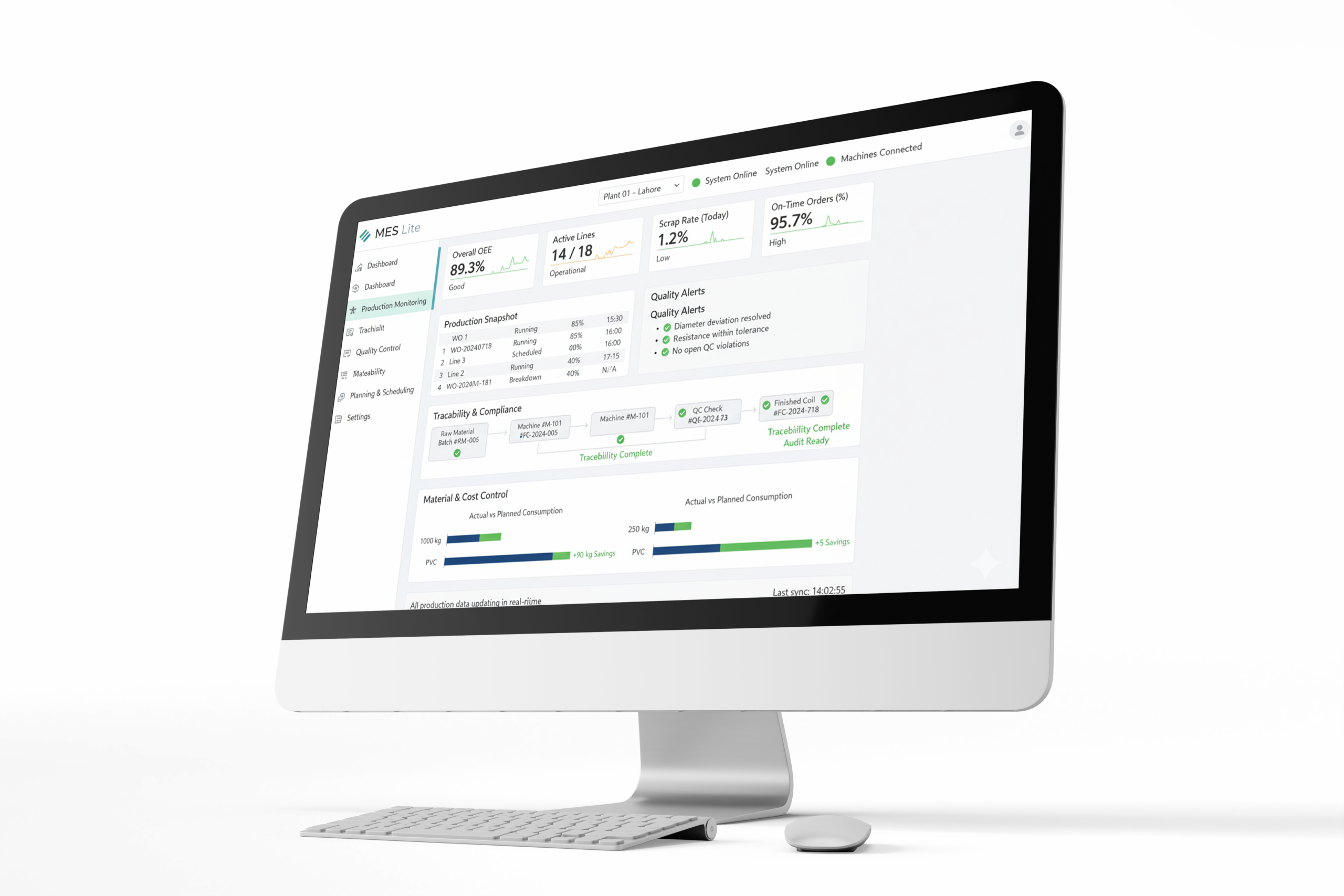

MES Adoption
MES Adoption for Productivity, Traceability & Quality Excellence
One of Pakistan’s largest and most respected manufacturers of wires and cables.1
Company Background: Powering Pakistan's Infrastructure
One of Pakistan’s largest and most respected manufacturers of wires and cables.1 A critical supplier to key national and international sectors, the company’s products are the backbone of:
Power & Energy Utilities
Operating two large manufacturing plants in Lahore, this boasts extensive capacity across the full production lifecycle, including copper rod casting, wire drawing, insulation, sheathing, armouring, and specialized compounding (PVC & XLPE). With a vast portfolio of over 6,000 SKUs, the scale of their operation is immense.2
The Operational Bottleneck
Despite their large-scale, high-value production, shopfloor operations were encumbered by traditional, manual methods:
- Heavy reliance on manual logs and Excel-based reporting.
- QC and downtime tracking utilized paper cards.
- Data collection was delayed, siloed, and often inaccurate.
This lack of digital integration created significant friction, masking operational inefficiencies, and hindering the company’s path to true manufacturing excellence.
Challenges Faced Without an MES
The reliance on manual and paper-based processes prevented from achieving optimal performance in a highly competitive, material-intensive industry.
Production Visibility & Control (The "Black Box")
Without real-time data from the shopfloor, management lacked true operational clarity.
Inaccurate OEE
Calculated OEE was skewed, leading to lost production hours and delayed, inaccurate decision-making.
Inefficient Use of High-Cost Materials
As copper and aluminum are the core cost drivers, material loss was a direct hit to profitability.
Quality Issues Due to Lack of Real-Time QC Data
Quality control was reactive rather than preventive.
Impact
Batches often failed after producing hundreds of meters, resulting in high scrap, costly rework, and inconsistent quality that led to customer complaints.
Compliance and Traceability Deficiencies
Certification bodies, utilities, and OEMs demand rigorous traceability for compliance and safety.3
Inefficient Production Planning & Scheduling
Planning was disconnected from the reality of the shopfloor.
Manual Paperwork & Reporting Overload
Operators and supervisors were burdened with non-value-added administrative tasks.
MES Lite – The Proposed Solution
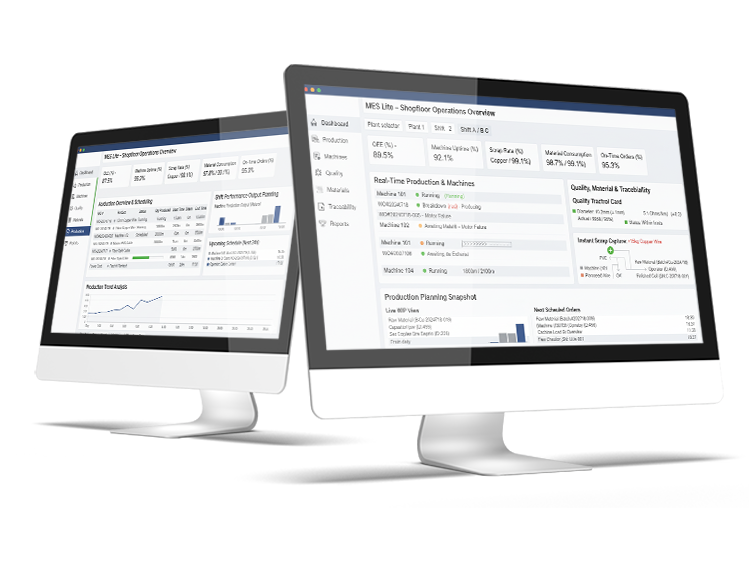
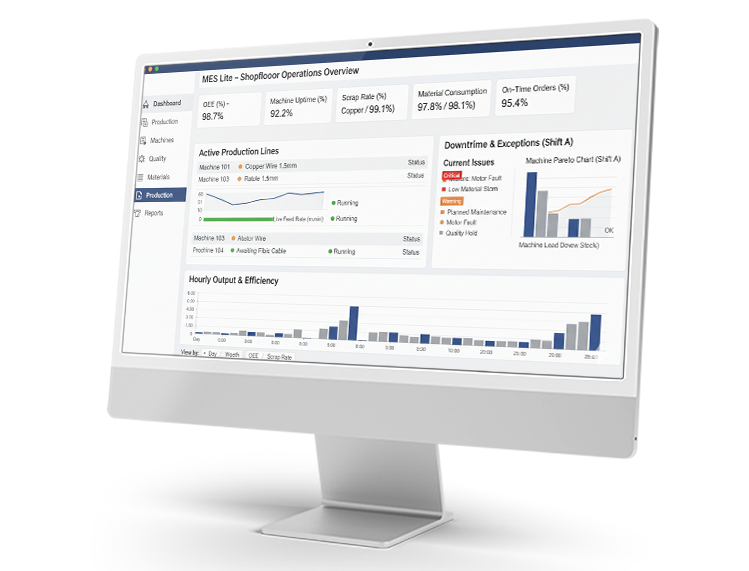
To directly address these challenges, opted for a focused MES Lite deployment, targeting the highest-impact areas first. The solution was designed to digitize the shopfloor and transform data collection from reactive to real-time.
Core Features of MES Lite:
| Module | Key Functionality | Value Proposition |
|---|---|---|
| Real-Time Monitoring | Automatic capture of machine status (running, idle, breakdown) and downtime reasons. | Accurate, immediate OEE calculation (Availability, Performance, Quality). |
| Digital Work Orders | Orders delivered directly to operator terminals with real-time progress updates. | Eliminates paper and ensures operators have correct, up-to-date instructions. |
| Quality Module | QC checks via tablet with real-time tolerance alerts (diameter, resistance). | Prevents long-run quality failures and reduces scrap and rework. |
| Traceability | Full genealogy from raw material to finished coil using QR codes. | Rapid complaint resolution and easier audit compliance. |
| Material Tracking | Actual vs. planned consumption with instant scrap capture and analysis. | Identifies copper and PVC over-consumption for immediate correction. |
| Production Planning | Real-time WIP view and machine loading dashboard. | Optimizes changeovers, improves scheduling, and enhances on-time delivery. |
Expected Improvements and Results
The implementation of MES Lite promised a quantifiable transformation across all operational metrics, delivering a significant competitive advantage.
Productivity (OEE + Throughput)
Total Loss Reduction - 10–25%
Overall reduction of 10–25% in hidden productivity losses.
Certification & International Client Readiness
Compliance: Automated capture of test and process records significantly simplifies audits for critical certifications like BASEC, KEMA, and VEIKI, boosting export readiness.
Scrap Reduction & Quality Excellence - 12–22%
Scrap Rate: Projected 12–22% reduction in scrap through real-time QC alerts, allowing operators to immediately correct diameter or insulation deviations before excessive material is wasted.
Business Case and ROI
The MES Lite investment was projected to have a rapid payback period, demonstrating that the cost was negligible compared to the magnitude of the savings in material, time, and quality.
| Benefit Area | Annual Gain (PKR) | Key Value Driver |
|---|---|---|
| Scrap Reduction | 40–70M | Real-time quality intervention. |
| Copper / PVC Optimization | 30–50M | Accurate yield measurement and consumption control. |
| Downtime Reduction | 20–40M | Faster maintenance response and micro-stoppage capture. |
| Productivity Improvement | 25–60M | Higher OEE and optimized throughput. |
| Complaint Handling / Quality | 10–15M | Automated records and rapid root-cause analysis. |
| Total Potential Annual Savings | 125–225M PKR |
The projected Return on Investment (ROI) was expected to be achieved within 6–12 months purely from material and efficiency gains.
Conclusion: A Strong Competitive Edge
The MES Lite adoption represents a strategic transformation. By transitioning from a manual, reactive operation to a data-driven, lean, and quality-focused production model, they gain an immediate and sustainable competitive edge.
The MES provides the critical foundation for:
- Real-Time Visibility and control over production.
- End-to-End Traceability for regulatory compliance.
- Significant Scrap and Cost Reduction in volatile high-cost materials.
- Readiness for International Certification and expanded export markets.
In the highly competitive cable and wire industry, where material cost volatility and uncompromised quality are paramount, the MES is not merely a software investment—it is the strategic tool that secures’ position as an industry leader for years to come.